
Bringing a new puppy home is exciting, but house training is often one of the first (and biggest) challenges new owners face. One of the most common questions is simple: how long will it actually take? The honest answer is that house training a puppy isn’t a fixed timeline—it depends on age, breed, routine, and consistency.
With the right approach (and realistic expectations), most puppies can be reliably house trained within a few months. Early guidance from trusted pet resources like Pet Control HQ can make the process far smoother, helping owners avoid common mistakes and set up good habits from day one.
Contents
The Short Answer: What’s the Typical Timeline?
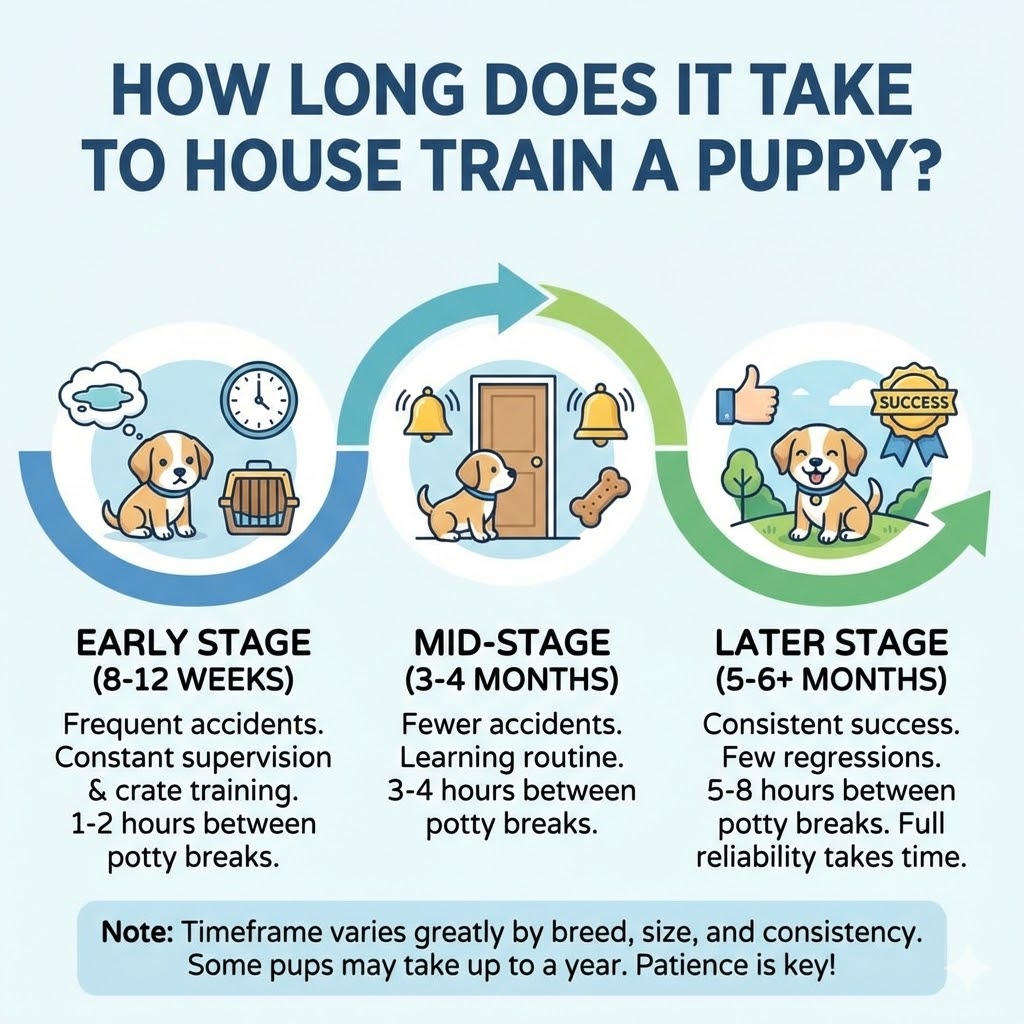
For most puppies, basic house training takes 8 to 16 weeks. During this time, they learn where to go, how to signal they need the toilet, and how to hold their bladder for age-appropriate periods. That said, full reliability – where accidents are rare and your puppy consistently asks to go outside – often takes up to 6 months, and sometimes longer for smaller breeds or particularly stubborn pups.
Average Time In months To House Train a Puppy
| Puppy Age | Typical Progress | What to Expect |
|---|---|---|
| 8–10 weeks | Just starting | Frequent accidents, needs potty breaks every 30–60 minutes |
| 10–12 weeks | Early learning | Begins recognizing potty routine but still inconsistent |
| 3–4 months | Improving control | Fewer accidents, can hold bladder 2–3 hours |
| 4–6 months | Mostly trained | Understands where to go; accidents usually due to distractions |
| 6+ months | Fully house trained | Reliable bladder control with consistent routine |
Average time: Most puppies are house trained within 4–6 months, but consistency, breed, and owner routine play a big role.
Why Age Matters So Much
A puppy’s bladder control develops gradually. As a general rule:
- 8-10 weeks old: Can hold for around 1 hour
- 12 weeks old: About 2 hours
- 16 weeks old: Around 3–4 hours
- 6 months old: Often able to last 6 hours or more
Expecting a young puppy to “hold on” for long periods will almost always lead to accidents. Frequent toilet breaks aren’t a failure—they’re a necessity at this stage.
Breed Size and Personality Play a Role
Breed can influence house training speed more than many people realise.
- Small breeds tend to take longer, as they have smaller bladders and faster metabolisms.
- Working and intelligent breeds often pick up routines quickly, but still need consistency.
- Independent or stubborn breeds may understand the rules but test boundaries.
Personality matters too. Confident, food-motivated puppies often respond faster to reward-based training.
Consistency is More Important Than Speed
The biggest factor in how long house training takes is routine. Puppies thrive on predictability. A strong routine includes:
- Toilet breaks first thing in the morning
- Toileting after meals, naps, playtime, and training
- Regular outdoor trips every 1–2 hours initially
- Going to the same toilet spot each time
When puppies know when and where they’re expected to go, learning accelerates dramatically.
Crate Training Can Shorten the Process
Crate training, when done correctly, can significantly reduce accidents. Dogs naturally avoid soiling their sleeping area, which helps them learn bladder control more quickly. Key crate training tips:
- Choose the right size (big enough to stand and turn, not bigger)
- Never use the crate as punishment
- Take your puppy straight outside after crate time
Used properly, a crate becomes a training tool – not a confinement solution.
Accidents are Normal (and Not a Setback)
Even well-trained puppies will have accidents. These usually happen because:
- The puppy wasn’t taken out soon enough
- Excitement distracted them
- The owner missed early toilet signals
Importantly, punishment doesn’t speed up learning. Calmly cleaning accidents and reinforcing successful outdoor toileting is far more effective.
Signs Your Puppy is Progressing Well
You’ll know house training is working when your puppy:
- Starts heading to the door or whining to go out
- Has fewer accidents each week
- Toilets quickly when taken outside
- Can hold longer between breaks
Progress often comes in noticeable leaps rather than a straight line.
When House Training Takes Longer Than Expected
If your puppy is older than six months and still having frequent accidents, consider:
- Reviewing your routine consistency
- Ensuring thorough cleaning of indoor accident spots
- Ruling out medical issues such as urinary infections
Sometimes a small adjustment in schedule or supervision makes a big difference.
🐶 Average House Training Timeline (By Breed Type)
| Breed Type | Typical Timeframe | Difficulty Level |
|---|---|---|
| Toy & Small Breeds | 4–6 months | Harder |
| Sporting & Working Breeds | 4–12 weeks | Easier |
| Hounds | 3–6 months | Moderate–Hard |
| Terriers | 3–5 months | Moderate |
| Intelligent Companion Breeds | 2–4 months | Easy |
🐕 Breed-Specific House Training Guide
Labrador Retriever
- Time: 4–8 weeks
- Why: Smart, eager to please, food-motivated
- Tip: Use treats + praise immediately after potty
👉 One of the easiest breeds to house train
Golden Retriever
- Time: 4–8 weeks
- Why: Gentle, obedient, thrives on routine
- Tip: Keep a strict schedule—missed breaks cause accidents
👉 Excellent for first-time owners
German Shepherd
- Time: 4–6 weeks
- Why: Highly intelligent, structured thinkers
- Tip: Combine crate training with command words
👉 Learns fast but hates inconsistency
Poodle (Toy, Mini, Standard)
- Time: 3–6 weeks
- Why: Extremely intelligent
- Tip: Mental stimulation prevents “revenge accidents”
👉 Toy Poodles may take slightly longer
Beagle
- Time: 3–6 months
- Why: Strong nose, easily distracted
- Tip: Always leash them during potty trips
👉 Knows the rules—chooses to ignore them 😅
Dachshund
- Time: 4–6 months
- Why: Independent and stubborn
- Tip: Crate training is non-negotiable
👉 Weather can completely derail progress
Bulldog (English & French)
- Time: 4–6 months
- Why: Relaxed personality, lower motivation
- Tip: Short, frequent potty breaks work best
👉 Slow learners but consistent once trained
Pug
- Time: 4–6 months
- Why: Small bladder + distractible
- Tip: Take out every 2 hours, no exceptions
👉 Adorable… but challenging
Border Collie
- Time: 2–4 weeks
- Why: Borderline genius
- Tip: Give a job—potty time becomes a “task”
👉 Often house trained shockingly fast
Chihuahua
- Time: 4–8 months
- Why: Tiny bladder, big attitude
- Tip: Indoor pee pads help during early stages
👉 Accidents are common—don’t punish
🧠 Why Breed Matters So Much
- Small dogs = smaller bladders = more accidents
- Smart dogs learn rules quickly
- Stubborn dogs learn rules… and test boundaries
- Working breeds crave structure and routine
Breed doesn’t decide success—but it does decide how patient you need to be.
⏱️ How to Speed Up House Training (Any Breed)
- ⏰ Fixed potty schedule (same times daily)
- 🏠 Crate training (safe, not punishment)
- 🍖 High-value treats only for potty success
- 🚪 Take puppy out after sleeping, eating, playing
The Key Takeaway
House training a puppy is less about speed and more about building lifelong habits. With patience, consistency, and positive reinforcement, most puppies become reliably house trained within their first few months at home. The effort you put in early sets the foundation for years of stress-free living—both for you and your dog. Stick with the process, celebrate the small wins, and remember: every successful toilet break is a step closer to a fully trained companion.
What Affects House-Training Time?
Several factors can speed things up or slow them down:
- Age: Puppies under 12 weeks have very limited bladder control
- Breed & size: Small breeds often take longer
- Consistency: Same schedule, same potty spot = faster learning
- Training method: Crate training often helps
- Owner involvement: Supervision and quick rewards matter a lot
Typical Timeline (Rough Guide)
- 8–12 weeks: Frequent accidents, learning basics
- 3–4 months: Fewer accidents, starting to signal
- 5–6 months: Mostly reliable with routine
- 6+ months: Occasional slip-ups, especially during changes
Tips to Speed Things Up
- Take your puppy out after waking, eating, playing, and before bed
- Praise and reward immediately after they potty outside
- Stick to a predictable feeding and potty schedule
- Never punish accidents—clean and move on